
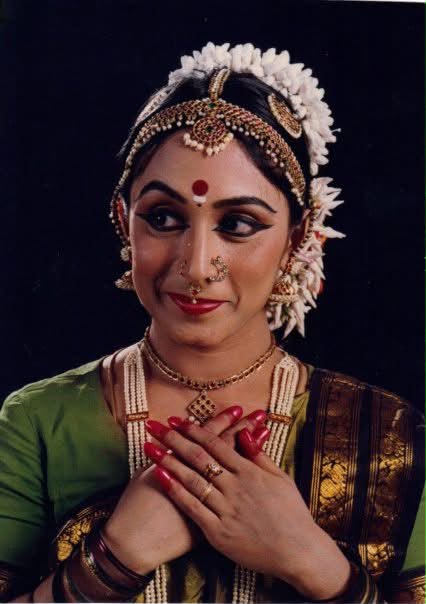
Sangeetha Padmasri Dance Academy Dr. Padma Subrahmanyam
Founder and Artistic Director – Sangeetha Sridhar
Sangeetha Sridhar is a distinguished Bharatanrityam artist, teacher, and choreographer, and a senior disciple of the legendary Padma Vibhushan Dr. Padma Subrahmanyam. Rooted in a rich tradition that bridges scholarship and performance, her journey in dance reflects a lifelong commitment to excellence, authenticity, and spiritual expression.
As a performer, Sangeetha has shared the stage with her Guru in numerous productions and has presented her art on prestigious platforms, including performances for Doordarshan and appearances in the acclaimed series Bharatiya Natya Sastra. Her artistry reflects both precision and depth, embodying the classical ideals of Nritta, Nritya, and Natya.
Trained at the renowned Nrithyodaya, Chennai, Sangeetha was among the first group of students to receive direct and intensive training in the 108 Karanas—the fundamental units of movement described in the Nāṭya Śāstra. This rare and rigorous training, under the guidance of her Guru, shaped her deep understanding of Bharatanrityam as a dynamic, holistic art form that seamlessly integrates movement, expression, and philosophy.
Beyond performance, Sangeetha is a passionate educator dedicated to preserving and transmitting this unique tradition. Through Padmasri Dance Academy, which she founded in Miramar, Florida, she mentors students in a method rooted in the Nāṭya Śāstra, emphasizing not just technique but cultural context, discipline, and artistic integrity. Over the years, several of her students have successfully completed their Arangetram under her guidance—each reflecting the depth of training and tradition she upholds. This year marks a significant milestone for the institution as it celebrates its 20th Arangetram.
Sangeetha has also played a significant role in fostering the arts within the community. She served as the Chairperson of the Cultural Committee at the Shiva Vishnu Temple of South Florida in its formative years, where she curated and organized numerous dance and music programs, contributing to the region’s vibrant cultural landscape.
Her artistic foundation is further enriched by her training in classical Carnatic music under her mother and Guru, Smt. Vasumathy Swamy. This musical grounding informs her nuanced approach to dance, particularly in rhythm, expression, and nattuvangam.


Her contributions to the arts have been widely recognized. She has been honored with the title Bharata Nritya Seva Mani for her service to her alma mater. She is a recipient of the Individual Artist Fellowship and was selected for the Folklife Apprenticeship Program for the art of nattuvangam, both from her home State of Florida.
Balancing her roles as an artist, educator, and professional, Sangeetha continues to enrich the cultural fabric of South Florida through performances, productions, and community engagement—carrying forward a timeless tradition with grace, scholarship, and devotion.
The Institution – Padmasri Dance Academy
Founded in 1999 by Sangeetha Sridhar, Padmasri Dance Academy is dedicated to nurturing young dancers in the unique and enriching tradition of Bharatanrityam, as envisioned by her Guru, Dr. Padma Subrahmanyam. Rooted in the principles of the Nāṭya Śāstra, the Academy offers a holistic approach to dance education that goes beyond the learning of movements and choreography.
Guided by the teaching philosophy of her Guru, Sangeetha strives to impart a comprehensive understanding of the art form, integrating dance with its allied disciplines of music, literature, aesthetics, history, and culture. Students are encouraged not only to develop technical excellence but also to cultivate a deep appreciation for the artistic, intellectual, and spiritual dimensions of Indian classical dance.
For over two decades, Padmasri Dance Academy has trained generations of dancers, many of whom have successfully completed their Arangetrams (both dance and nattuvangam) under Sangeetha’s guidance. The Academy also provides numerous performance opportunities through its Nritya Aradhana series, enabling students to gain valuable stage experience while sharing their art with the community.
Service and cultural engagement form an integral part of the Academy’s vision. Students regularly participate in religious, charitable, and community events, using dance as a means of offering, learning, and giving back. The enduring bond between Guru and disciple is reflected in the many alumni who return to the Academy during college breaks and later in life to continue their advanced studies, reaffirming their lifelong connection to the art and the teacher.
At its heart, Padmasri Dance Academy seeks to create not merely performers, but informed, sensitive, and culturally rooted artists who carry forward the timeless values of India’s rich artistic heritage.

Sangeetha with her Guru Dr. Padma Subrahmanyam
Guru – Dr. Padma Subrahmanyam
Yad Yad Karma Karomi Tat Tat Akhilam Shambo Tava Aaradhanam
O! Lord, Whatever activities I do, all of them in entirety constitute your worship.
The Vedic culture with its emphasis on Sanskrit, bound the whole of India with a common religion philosophic ethos which particularly influenced the aesthetic approach in the art forms. Literature, painting, sculpture, dance and music as well as theatre all strived to move on the same spiritual path. In this integrated approach, each discipline gave unto others and also drew from them. What was expressed with words in poetry or literature acquired a visual dimension in the dance and what the dance did inspired the sculptor who immortalized the movement from dance on stone. The poetic word wrapped in the harmony of melody has always provided the textual format for the dance compositions. All art forms were part of one canvas. The total theatre of India was discussed in a treatise on dramaturgy called the Natya Sastra.
In her research, Dr. Padma Subrahmanyam found movements frozen in sculptures and looked for the dynamism of those movements. Soon she was practicing those movements in her dance and proved that Karanas as commonly believed then were not static poses in dance but unit movements. She began to use the Karanas she was studying in her dance. In her study of Nāṭya Śāstra, Dr. Padma found that among the three kinds of expression of body language of dance as described in it, Nritta (body language), Nritya (expression combining body and facial expressions) and Natya (drama), the term Nritya applied the best to the practiced dance form now called Bharatha Natyam and called her dance Bharatha Nrityam.
Padma Subrahmanyam is credited with recreating a tradition called Margi. Margi as sighted in the Nāṭya Śāstra is the classical tradition and Desi is the regional style that is practiced in the different regions. Margi was a classical style that united the entire Indian sub-continent panning from Afghanistan to the Indonesian islands.